21 March 2007

Déjà Vu All Over Again

Right: In a previous century, I had not yet even left Las Vegas

You know, last year when I was getting ready to fly to the U.K. for the purposes of having a (safe) adventure, I was merely terrified. This year terror has given way to a strange sadness to be leaving 99.9% of the people I know on this planet 6000 miles away from where I'll be for the next six months. Last year the thought of going to a foreign, if not exactly strange, country for the better part of five months crowded out a lot of other thoughts. I knew I'd be uncertain and things would be unfamiliar, but I was unprepared for how lonely I was going to be, and the depth of my isolation came as something of a shock. This time I feel it before I've even stepped onto the plane.

And step on I will, this very evening. And if six months living in a rented room in London were my only object, I'd probably be cashing in my ticket, much as I love the place. But this time I have cleverly included a purpose in my visit that will keep me walking down the jetway: I'll be attending a practitioner training in Neuro Linguistic Programming (NLP) in April, and a further training in September. See how I got my hooks into myself?

I wouldn't want you to think I'm not looking forward to my stay in Dr Johnson's city, 'cause if I couldn't provide all of you with some entertainment between now and mid-September my life would have exactly no purpose worth mentioning. So watch this space for sparkling travel commentary, and if you can't find any of that, please read what I post. It'll make me feel good.

18 September 2006

Rootless in Seattle


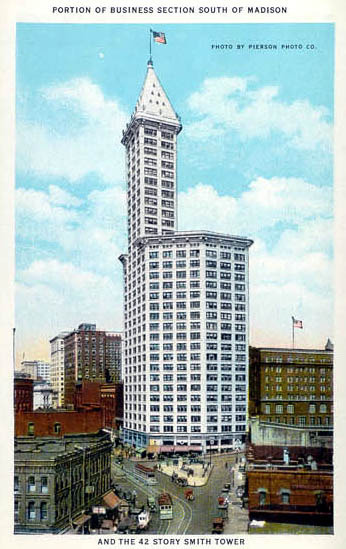
Right: How can you not love a city with a landmark building that looks like one of these? The Smith Tower

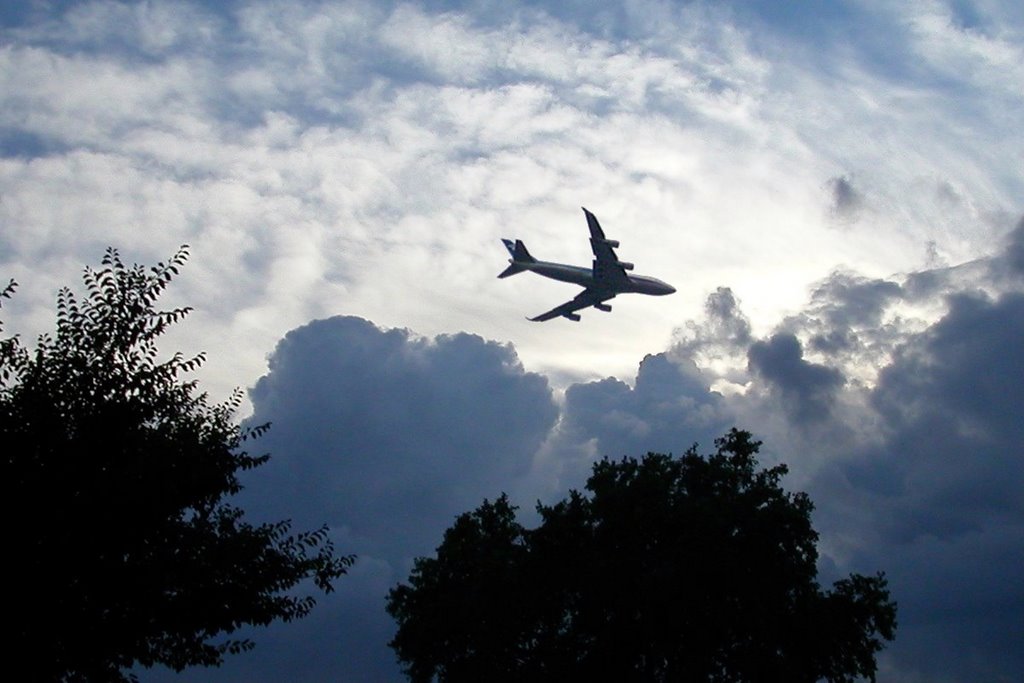
I returned to Seattle as scheduled in mid-August at the end of a comfy and blessedly uneventful flight from Heathrow. Of course the flight left an hour late, and I spent two of my four hours at the airport queueing up for flight check-in, but they were handing out bottles of water, and except for a loud and protracted battle of words between two women heading to Nigeria about whether one of them had jumped the queue (she hadn't), everyone was in pretty good spirits. They were at least flying, after 6 days of cancelled flights and protracted delays.

As an entirely unforseen bonus, I was treated to a full-body scan consisting of three artfully-posed x-rays. I suppose they had to pick someone utterly outside their target group, and I was the token white woman. I didn't mind, really, except for the fact that they wouldn't sell me prints.

After Indian food (cures jetlag instantly) and a couple days' readjustment, it was time for a road trip to L.A. One World Science Fiction convention later I came back just in time to go on another road trip, this time to Sacramento. I've lost track of the number of times I've promised myself never to go anywhere by car, but it's a lot.

Anyway, I'm settled into a basement room in Beacon Hill, and I'll be here until April, at which time I'll fly back to the U.K. and resume reporting my outsider's view of all things British with a few dozen more teatime chats between April and October. Between now and then I'll post anything earth-shaking that comes up.

Cheerio, mates!
Bridget

14 August 2006

Friendly Skies


Unless you’ve been living on one of the outer planets since the 10th of this month, you know that a plot was uncovered to blow up a dozen or so airliners on their way from London to the U.S. Apparently the wannabe bombers who were arrested on the 10th had purchased tickets to fly Wednesday the 16th, by amusing coincidence (depending on how easily amused one is) the day I’m flying back to the States.

I’m assuming if anyone’s really worried about any bombers still at liberty holding tickets for that date and capable of smuggling explosives onto planes in the face of the security regulations currently in place (making something of a case for full body cavity searches across the board – “Welcome to British Airways, the world’s best-loved airline. Now bend over”) they’ll cancel all flights to the U.S. that day. Of course if they do I’ll be moving into the International Departures lounge at Heathrow, since my neighbor Steven will be moving into my room before the bed’s cool. His present room is even smaller than mine, and he’s trading up.

I was on the Tube on Thursday morning as all this was developing, and the driver announced that anyone who was on their way to Heathrow should call their travel agent and find out if their flight had been cancelled before going to the airport. About five minutes later he came on again and said anyone who was on their way to Heathrow should just turn around and go back. MI5 considers the U.K. to be under attack, the threat level (yes, they have that here, too) is Critical, and BA is cancelling 30% of their short-haul flights to keep their terminal staff from imploding under the pressure of thousands of cranky customers, thereby creating thousands more cranky customers. Still the city remains reasonably cheerful, and Tony Blair didn’t even come home from the Caribbean - I think he’s taking George Bush lessons by correspondence. There’s a deputy Prime Minister, but when all this came down the Home Secretary told him to go play on the motorway and took over the government.

So just another week in Old Blighty, thankfully a cool and rainy one. If I don’t see you in the Blogoverse before that time, I’ll be seeing some of you in Seattle on Wednesday afternoon. Remember, the best cure for jet lag is paneer butter masala with an order of garlic naan, and some baklavah with Lebanese coffee for dessert. Keep ’em flying.

07 August 2006

Jack the Ripper? Or Nice Old Man?


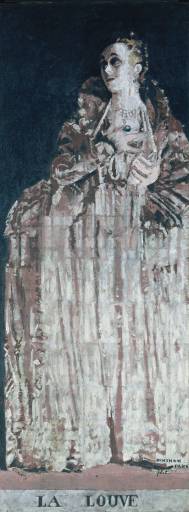
Right: Miss Gwen Ffrangcon-Davies as Isabella of Spain, by Walter Richard Sickert, collection of the Tate Gallery.


If one spends any time in the Tate Britain looking at late 19th and early 20th century British paintings, one will encounter the works of Walter Richard Sickert (1860-1942), currently the front runner in many peoples’ minds to have committed the murders credited to “Jack the Ripper.” Patricia Cornwell, author of the immensely popular Kay Scarpetta series of doorstop crime novels, spent a fortune pursuing her opinion that Sickert was indeed the infamous Whitechapel murderer, and if one credits her detective work and that of experts in forensic science who recently re-examined the evidence still held at New Scotland Yard, the implications seem pretty damning (Portrait of a Killer - Jack the Ripper, Case Closed, by Patricia Cornwell (Berkley, 2002). Not everyone agrees with her conclusions, most particularly surviving relations of the artist. Cornwell quotes someone at Scotland Yard as saying the re-examined evidence would make for an easy conviction, but her detractors quote their own experts as saying the evidence is still far from clear.


Sickert was in his own time a well-known British painter, highly regarded by his contemporaries. He studied under James McNeill Whistler, and was a personal friend of many artists of that period. He is credited with being a “principal conduit of French aesthetics into Britain (http://www.tate.org.uk/),” and with championing both Impressionism and Post-Impressionism when those movements were decidedly unpopular with British art critics. The Tate Britain owns a number of his works, and many more are in other museums and private collections. The late Queen Mother was an avid collector of Sickerts.


As a painter, Sickert seems to have been inordinately fond of browns: browns greyed out and toned down and stepped on with a muddy boot, reds and oranges made brown, blues and greens dirtied down to unpleasantness. Given the undeniable benefit of hindsight, his reds often resemble dried blood. He painted Venice as though there were no yellow in the sunlight, and in many of his plein air works seems to be painting from a shadow into a shadow, with the sun a distant presence barely making itself felt in some part of the sky. A few of his paintings of Dieppe are rather nice, but most are just brown.


I confess I don't get his elevated status in the art world. Most of the Sickerts I’ve seen are either forgettable or worse, not forgettable because they are more than a bit disturbing, especially those which feature people. Not beautiful and disturbing, but butt-ugly and disturbing, in my humble opinion. His portrait of Aubrey Beardsley is agreeable enough (though made up entirely of browns), but his self-portraits don't depict anyone I'd want to know (although a photographic portrait taken perhaps a year previous to his death shows a pleasant-looking bloke who doesn’t look within 15 years of his age, and who might easily be your friend’s grandfather or even your own), and his paintings of women are almost uniformly unpleasant in some way in addition to the palette. His women sometimes have faces too ugly to be from life, such as La Hollandaise, a fleshy nude by moonlight with the face of a nightmare, and Two Women on a Sofa – Le Tose. This is a nice composition of two young women in a relaxed pose, but he could not have found two faces that hideous had he advertised throughout France, so I’m left to suppose the monstrosity came from within. None of these opinions would be admissable as evidence in a court of law, but there you are.


One of Sickert's most fascinating works I’ve seen in person is Miss Gwen Ffrangcon-Davies as Isabella of Spain (see photo above). This is a larger-than-life-size painting of an actress Sickert knew and admired, but I can never get over how inhuman is his portrayal of her. Even making allowances for stage makeup, the woman reminds me of an upright corpse.

So we’ll never know if Walter Sickert was indeed the man who murdered five prostitutes in London and wrote letters to the police and newspapers bragging about it, but we can still look at his art and wonder if it was created by a monstrous psychopathic killer, or if the old man who died in 1942 was no more than a prolific and well-regarded painter who may have had a slight problem with his attitude toward women. Either way he’s beyond harm or the ability to harm at this point, and standing in front of one of his monster-women at the Tate and feeling a slight frisson is – thankfully – as close as any of us is likely to come to the reality of Jack the Ripper.

31 July 2006

The Tube


I had never ridden an underground train before my first visit to London. My years in the Los Angeles area were happily behind me long before they built theirs, and my one short visit to New York was accomplished without the subway experience. I admit to having been somewhat intimidated by the idea of the Underground, but one visit convinced me there couldn’t be a simpler or faster way of getting around a big city. If you know which station you’re in and which one you’re going to, and if you can read, you can get there with little or no hassle for a little more than the price of a bus fare, and a lot less than a taxi.

While waiting to pick up a Britrail pass before a long-ago visit here, I overheard a travel agent telling a couple of clients that they might find the tube too intimidating, and perhaps they’d be better off learning the bus system to get around town. It was all I could do not to rush into her office and set them all straight (and you know I could, too…). I’ll grant you that aboveground travel has its advantages, especially for tourists, but even the most casual tourist owes it to her experience of London to check out tube travel, and anyone interested in getting from one place to another quickly and easily had better either pony up for cab fare or head underground.

One of the things that makes tube travel simple is the universe-famous Tube Map, developed by an electrical draughtsman who did for the Metropolitan Railway what he did for electrical circuits: made it simple and easy to follow. By assigning a different color to each railway “wire,” and simplifying the geography considerably, Harry Beck created, 73 years ago, a travel diagram that’s been the inspiration for any transport map you’ve ever seen. Inside every train carriage is an even more simplified diagram of the line you’re riding, with the wire stretched out into a straight line. From any seat you can glance up and see where you are along your journey.

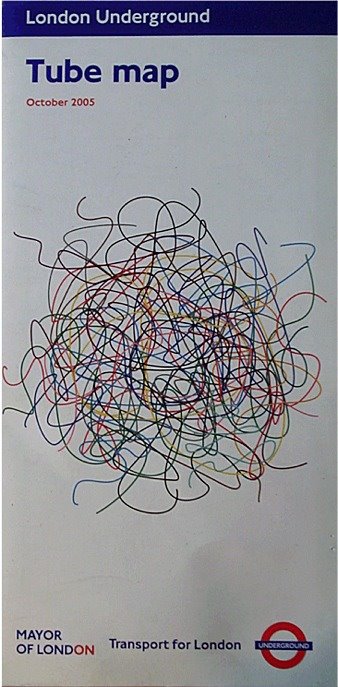
Everyone understands, of course, that the map is not the territory, and the Tube Map doesn’t represent the Underground exactly. But it wasn’t until last year, when Transport for London unveiled the actual map (see photo) that Londoners understood what a simplification it truly was. You can be sure they forgot again as soon as they possibly could.

Riding during rush hours can be a real sardine-tin experience, and during heat waves like the one we’ve been having here the last few weeks, you’ll hear recordings warning you to carry water. Last week a man was mugged for a 40p bottle of water by a well-dressed fellow-passenger whose thirst overcame him on a day when the recorded temperature underground was 47C (117F). When he wouldn’t surrender the water voluntarily, the aggressor snatched the bottle and drank from it until the train stopped at Bank, then he got off with it and walked away. I’d say carry some for yourself and some for your mugger.

18 July 2006

What I Know About Cricket


Right: This man has no future in cricket.


I have not yet been to a cricket match, but living as I do within a half-mile of the Kennington Oval, I have listened to the roar of the crowd on a few occasions, and it made me wonder: suppose you were attending a cricket match and your team did something advantageous, like… score. How would you know? This burning question has led me to make a serious study of a sport that probably has more fans worldwide than baseball, but which is tragically misunderstood in less civilized nations.

There are no rules in cricket, but since 1744 there have been Laws. Built into these Laws is something called the Spirit of the Game, which is not entirely definable; players are nonetheless required to abide by it. One is not allowed to dispute an official’s decision, which means Gary Payton could never play cricket. No violence is permitted, which leaves out Ron Artest as well. Good thing us unruly Yanks have the NBA.

Violence in cricket consists of rudeness to an opponent, an official, or anyone, really. Also questioning a decision, or spiking the ball. Since rudeness is not covered in the Laws, penalties are decided on the spot by a referee. No-one knows what the penalty for actual violence might be, because it doesn’t happen.

A cricket side is made up of a bowler, fielders, and batsmen. A bowler bowls. Overhand. He does not pitch. The “pitch” is the 22 yards of ground between the batsmen.

Before a match, the captains meet up to decide on the boundaries of the playing field, how long the match will last, and what time everyone will retire from the field for tea. You probably think I’m kidding. A spur-of-the-moment match might be over the same day it begins; more leisurely ones can take up to five days to finish, and the team with the most runs doesn’t always win.

The batsman stands in front of something called a wicket. Breaking a wicket dismisses the batsman, and doing so is also called a wicket, and a wicket not having been broken, and the batsman not being out can also, if one chooses, be called a wicket. Now you begin to see why Americans often come away from a cricket match convinced they’ve just had one put over on them by thousands of practical jokers who showed up for no other purpose.

The bowler’s objective is to break the wicket, and the batsman’s to prevent him from doing so. The fielders (who can be deep, backwards, or silly) run around and ask the umpire to “give” the batsman out, because unless they do, he can’t. There are two batsmen on the field at a time, on opposite ends of the pitch, and now and again they run back and forth to one another’s wickets a few times. Because there are eleven players to a side, eventually there’s only one batsman left, who neither bats nor runs, but rather stands there until the captains tell him to go home.

In addition to bowlers, batsmen, fielders, umpires, and a referee, the following things have also been reported by reliable observers during a cricket match: Dollies, Ducks, Featherbeds, Gardening, Lollipops, Maidens, Minefields, Puddings, Rabbits, Yorkers, and Zooters. This is only a partial list, but should help you understand the innate seriousness of the sport, and the dangers faced by the brave athletes who play it.

I hope this explanation will further the cause of friendship between our two great nations. Perhaps instead of sending more troops to Iraq, Tony Blair would like to send a few cricket sides to America to teach the game to young Yanks. It couldn’t be any more ridiculous, and barring mishaps with Minefields (and for all I know, Zooters), the death toll should be far less.

19 June 2006

Still Laughing…

I can still remember my first look at Oxford Street: I peeked around a corner at it and saw this wide thoroughfare absolutely packed to bursting with taxis and buses and merrily-jaywalking pedestrians – how did any of them survive? I didn’t have any reason to walk into that utter tumult, nor any desire to, particularly, so I headed in the other direction. On some later visit a friend asked to meet at a coffee shop in Oxford street, and I was so intimidated by the prospect that I went several hours early and scoped out my route and destination ahead of time so I’d have some degree of confidence when I went later. If you know me, you would be justified in thinking that degree of intimidation unusual, but never having lived in a really big city, I’d never encountered anything quite like Oxford Street. Now it only seems really big, rather than really big and unconquerable, but when I wrote a novel about Hell, I put a street there something like it.
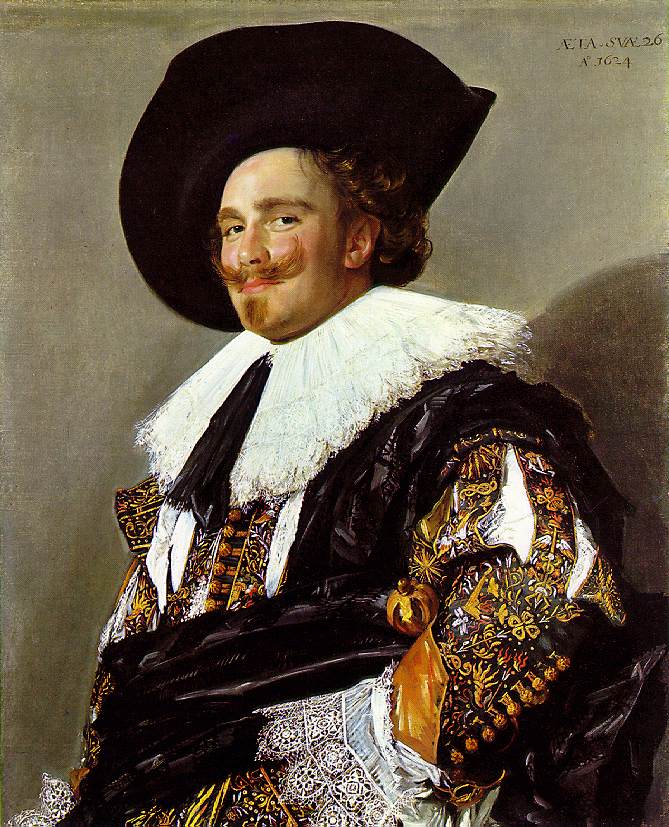
Oxford Street tube station is the nearest to the Wallace Collection, one of London’s finest art museums. Like most museums in London, there’s no admission charge, only a discreet request for donations.* This was once the home and private collection of several successive Marquesses of Hertford, until the widow of one of them willed it to the State. It’s truly breathtaking, and contains stunning examples of furniture, ormulu clocks, sculpture, paintings, and arms and armor, as well as thousands of smaller items, covering several centuries. One visit would be enough only to take in a portion of the whole, but on every visit you really must see the crown jewel of the show, the painting for which some Marquess of Hertford or other paid more than for anything else in the whole immense mansion: Franz Hals’ The Laughing Cavalier, painted in 1624. He’s in the Great Gallery with a lot of other Dutch School pieces nearly as famous as he is, but he outshines the rest like the sun does a 60-watt lightbulb. Below are the notes I wrote during my second visit; I think I said it then at least as well as I could say it now.

“From Oxford Street I walk to the Wallace Collection in Manchester Square. I came the first time mainly to see The Laughing Cavalier, by Franz Hals, the jewel of the Wallace Collection. Of course the entire collection is wonderful, with masterpieces by dozens of prominent artists, but I could hardly take my eyes off this particular painting on my first visit, and only tore myself away by promising to come back and see him again.

After visiting every other room in Hertford House, I finally enter the Great Gallery, and after revisiting the other paintings in the room, take a seat on the Victorian parlor settee in front of The Laughing Cavalier. It's an odd title, considering that while many of Hals' subjects actually do smile broadly or otherwise demonstrate uproarious good spirits, the Cavalier wears only the ghost of a smile for his portrait. Perhaps Hals knew something about his subject that we don't; certainly his good humor is evident in the painting. He looks like someone you'd really like to know.

Two British ladies walk by at a brisk pace, heels rapping sharply on the floor of the Great Gallery. One of them says, "Oh, look. The Laughing Cavalier. Ever think you'd get to see that?" By the time she finishes the question she's already past the Rembrandts, and I never hear her companion's answer. They continue on down the room without even slowing down, and disappear out the far doors. At that rate I reckon they got through the entire collection in under twenty minutes.

Other visitors stop, call their friends over, exclaim delightedly at his pose, his evident good nature, the rendering of detail in his costume. Last time it was just me and the Cavalier, but this time I'm enjoying the obvious pleasure of others at getting to know him. A British family have just discovered the painstakingly detailed lace on his sleeve, and I point out the change between this and the eye-fooling non-specific detail in his collar, as though Hals hadn't wanted any fussiness to compete with his Cavalier's face – the real star of the painting.

He outshines the Murillos, van Dycks, Rembrandts – all of them. They glow, but he sparkles. His eyes, which are so dark as to look brown from a distance, are actually a deep blue-grey seen up close. There are 67 paintings in this room, and his is the only one framed in black. The other 66 are surrounded by gilt frames, but some wise curator apparently knew how to make him stand out in a crowd, not that he wouldn't on his own.

Several people remark on the fact that his eyes seem to follow one around the room. The fact is that any subject who's painted looking directly at the painter will appear to follow viewers with his or her gaze. The adult figures in the two nearby Rembrandts do the same, but no-one remarks it. I know the secret, of course; The Laughing Cavalier stands out in this regard because as they walk away they keep looking back at him.

I strike up a conversation with a man who's nearly as taken with the Cavalier as I am. “I tried to tell myself I wasn't coming here today just to see this,” he says, “and then Voom! ” He pantomimes himself making a beeline for the Great Gallery. We discuss the composition of the painting and how the eye is led around it and always back to the face, framed by that rakish black hat.

I stay probably half an hour, then reluctantly tear myself away again, promising, as I do every time, that I'll be back again to see him.”

And of course I did go back, and thanks for indulging my deep love of a 400-year-old man this time – I’ll talk about some of the other Wallace wonders in a future installment.

*At the Victoria & Albert – the National Museum of Design – the request is famously less discreet, as guards stand by the perspex donations boxes and glare at you, daring you not to empty your pockets. If you can’t afford a donation, here’s the way to avoid them: turn left as soon as you come in the main entrance, and proceed down to the toilets. You’re going to be there several hours, so you’ll be glad you stopped. When you come out again, angle sharply to the left as you come up the stairs, and pass behind the pillars, boxes, and guards. It can’t be said I haven’t learnt to live here cheaply.

12 June 2006

When in Bath

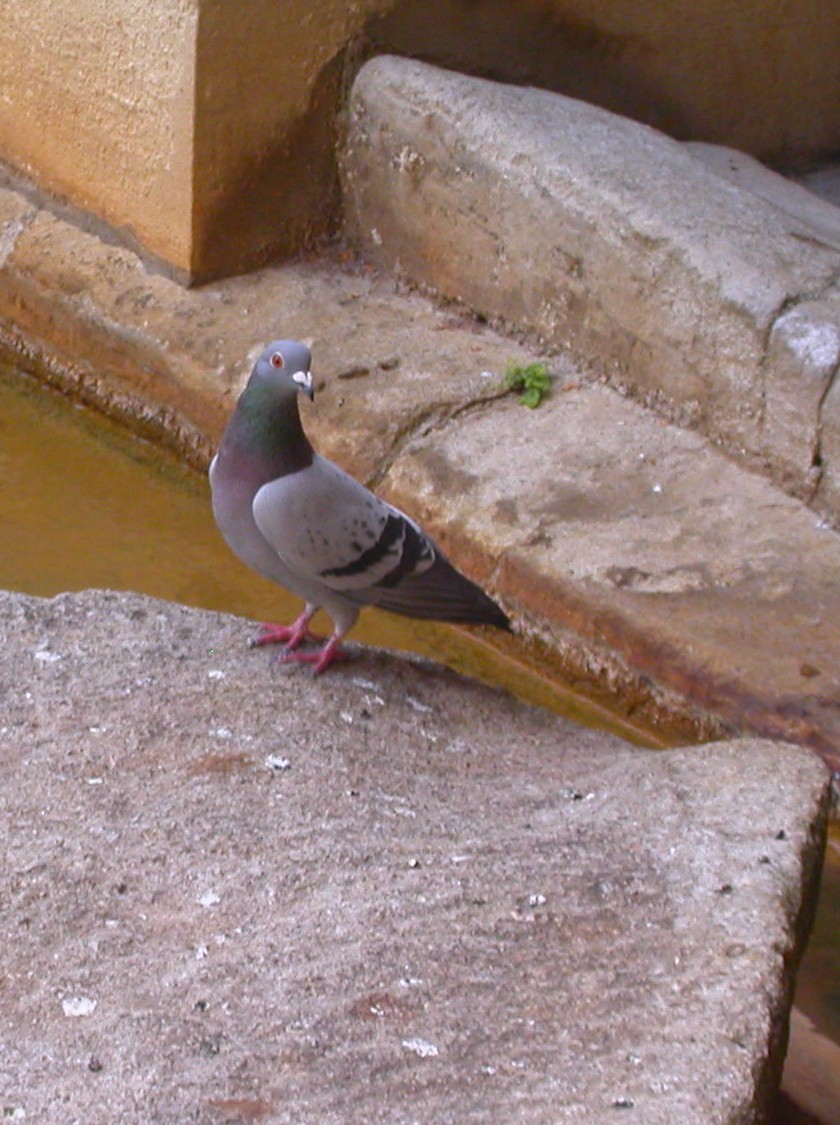
Right: One of many visitors to Aquae Sulis

Bathing is not allowed in Bath, at least not in the Baths. Of course one look at the water would encourage a desire to shower. Somewhere else. During Roman rule this place was called Aquae Sulis after the local goddess who provided Britain’s only natural hot mineral spring, a real attraction for bath-loving Romans. They had the good sense to roof the place over so pigeons wouldn’t shit in it from morning until night, which the Victorians who rediscovered it twenty feet beneath a row of flooding houses in the 1850s did not. So you probably wouldn’t want to bathe where the Romans did, but the water that flows into the spring is clean enough to drink after 10,000 years of natural slow filtering since it fell as rain in the local hills - and before it gets exposed to the depredations of pigeons - and the British have been drinking and immersing themselves in that water since before they ever heard of Claudius or Julius Caesar. It has been rumored to cure any malady you can come down with. Finding the Roman incarnation of the place conveniently situated to the springs they were still bathing in was a bonus for the 19th century residents of Bath. Even now, after nearly everyone has stopped believing in the curative powers of the waters, about a million people a year still show up just to see the place. My glass of Bath water was free with my admission, so before I left I took myself to the Pump Room, where Jane Austen used to partake of the local social scene, and tried a glass. It was quite warm, having been drawn from a bronze fish’s mouth directly at the “King’s Spring,” a little mineralish, and not at all bad compared to London tap water.

Jane Austen lived here for five years, off and on, and never warmed up to the place. Even in 1801 it was full of tourists, being right between its height-of-fashion pleasure mecca period and its British-equivalent-to-Florida retirement mecca period. It was too noisy for a country girl, and too bright (white stone neo-classic buildings were all the rage), and she wanted to be back in Hampshire. The day I went it was also hot and crammed with shoppers, and I got lost a lot on account of the rather cavalier attitude towards street names on the tourist maps, but a pot of assam and a couple of crumpets with marmalade in the tea room on the top floor of the Jane Austen Centre in Gay Street kept me from expiring.

I was feeling a bit pensive, thinking about Jane’s too-short life, too much of which was spent in relative poverty after the death of her father. At least she didn’t have to die to be successful; her books were popular once they finally saw publication, and made her some money in the last six years of her life. I’m an avid fan of Jane’s – I can read Pride and Prejudice and Persuasion, particularly, every year or so, and still feel the same emotional suspense as I did the first time. That’s a gift: Jane’s remarkable gift, and her gift to me. “Here’s to you, Jane.” I raise my teacup in the general direction of Winchester Cathedral, where her headstone bears no mention of her slightly disreputable profession. “Here’s to you, old girl.”

06 June 2006

Here There be Romans


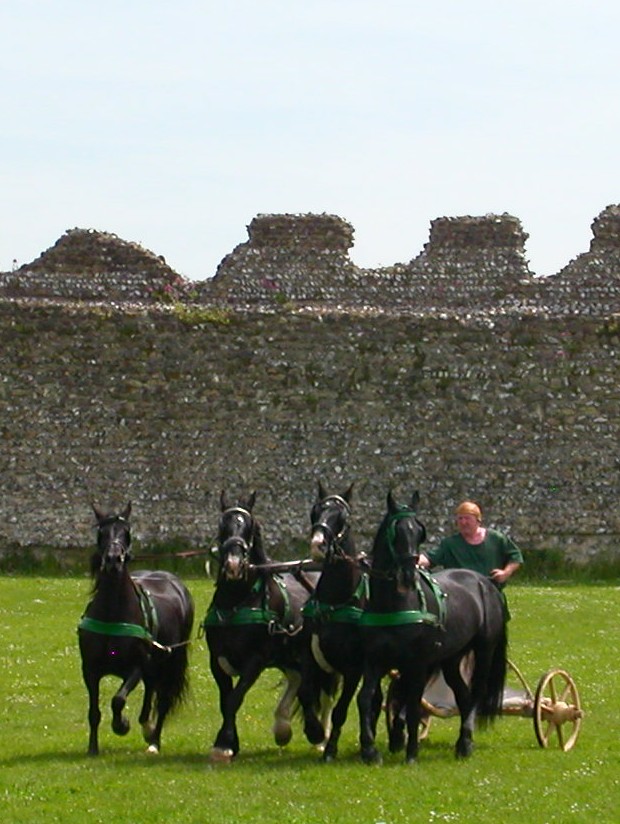
Right: Quadriga and Roman Wall, Porchester, Hampshire

You probably thought there were no Romans left in Britain, but there were dozens of them running around Porchester on Sunday, and the proof is in the photograph (More are available via the link to photos at the right). Members of three Romano-British re-enactment groups – the Ermine Street Guard, Britannia, and ERA (End of the Roman Age) turned out in force and fancy-dress for English Heritage’s Roman Festival held there over the weekend. They fired ballistae, ran one another through with swords and spears, and demonstrated Britain’s first reproduction of a Roman racing chariot, here driven by Tony Smart, who provides horses and his riding skills for films and TV.

The four-horse racing chariot, or quadriga, was donated to English Heritage by Time Team, a popular archaeology show on British TV. The show’s archaeologists had excavated a chariot-racing track, and subsequently commissioned the reproduction of a chariot to run on it. Although no hard evidence had been found before last year , it had been long surmised that there must have been chariot racing in Britain during Roman rule. Chariot racing was bigger than football, bigger than lions eating Christians, bigger than anything in Roman entertainment. Chariot racers, who seldom saw the far side of 30, were celebrities on a scale we can scarcely imagine unless we envision David Beckham being canonized after winning the Nobel Prize. The most famous chariot-racing riot in history resulted in 30,000 deaths, which makes a football riot seem like a few of the lads messing about after a match.

Three more quadrigae are being built, and next year’s festival will feature a race among the four famous Roman racing factions: the Blues, the Greens, the Reds, and the Whites. Perhaps English Heritage can organize modern Britain’s first chariot-racing riot, and if that doesn’t sell admissions, I don’t know what would.

Dev Agarwal had kindly agreed to chase Romans with me again, and we drove down to Hampshire (Jane Austen Country) on England’s south coast Sunday morning and spent the hottest day of the year to date watching demonstrations of battle tactics, sword- and spearplay, and Roman field surgery. I cannot imagine running around in armor, helmets, and in some cases bearskins, as these hardy re-enactors did, and they did it with smiles on their faces. There’s a photo of Dev looking remarkably cool in the ruins of Porchester Castle among the other “best-of” shots of the day – just follow the photo link at right. After collecting sunburns and souvenirs (I found the perfect desk accessory for you, Mr Dougie), we battled traffic back to Whitton and had coffee and dessert with Terri and Rani before I headed for home, nicely satiated with conquerors and tiramisu, to spend the evening reading slush. I would dearly love to be back next year for the big race.