19 June 2006

Still Laughing…

I can still remember my first look at Oxford Street: I peeked around a corner at it and saw this wide thoroughfare absolutely packed to bursting with taxis and buses and merrily-jaywalking pedestrians – how did any of them survive? I didn’t have any reason to walk into that utter tumult, nor any desire to, particularly, so I headed in the other direction. On some later visit a friend asked to meet at a coffee shop in Oxford street, and I was so intimidated by the prospect that I went several hours early and scoped out my route and destination ahead of time so I’d have some degree of confidence when I went later. If you know me, you would be justified in thinking that degree of intimidation unusual, but never having lived in a really big city, I’d never encountered anything quite like Oxford Street. Now it only seems really big, rather than really big and unconquerable, but when I wrote a novel about Hell, I put a street there something like it.

Oxford Street tube station is the nearest to the Wallace Collection, one of London’s finest art museums. Like most museums in London, there’s no admission charge, only a discreet request for donations.* This was once the home and private collection of several successive Marquesses of Hertford, until the widow of one of them willed it to the State. It’s truly breathtaking, and contains stunning examples of furniture, ormulu clocks, sculpture, paintings, and arms and armor, as well as thousands of smaller items, covering several centuries. One visit would be enough only to take in a portion of the whole, but on every visit you really must see the crown jewel of the show, the painting for which some Marquess of Hertford or other paid more than for anything else in the whole immense mansion: Franz Hals’ The Laughing Cavalier, painted in 1624. He’s in the Great Gallery with a lot of other Dutch School pieces nearly as famous as he is, but he outshines the rest like the sun does a 60-watt lightbulb. Below are the notes I wrote during my second visit; I think I said it then at least as well as I could say it now.

“From Oxford Street I walk to the Wallace Collection in Manchester Square. I came the first time mainly to see The Laughing Cavalier, by Franz Hals, the jewel of the Wallace Collection. Of course the entire collection is wonderful, with masterpieces by dozens of prominent artists, but I could hardly take my eyes off this particular painting on my first visit, and only tore myself away by promising to come back and see him again.

After visiting every other room in Hertford House, I finally enter the Great Gallery, and after revisiting the other paintings in the room, take a seat on the Victorian parlor settee in front of The Laughing Cavalier. It's an odd title, considering that while many of Hals' subjects actually do smile broadly or otherwise demonstrate uproarious good spirits, the Cavalier wears only the ghost of a smile for his portrait. Perhaps Hals knew something about his subject that we don't; certainly his good humor is evident in the painting. He looks like someone you'd really like to know.

Two British ladies walk by at a brisk pace, heels rapping sharply on the floor of the Great Gallery. One of them says, "Oh, look. The Laughing Cavalier. Ever think you'd get to see that?" By the time she finishes the question she's already past the Rembrandts, and I never hear her companion's answer. They continue on down the room without even slowing down, and disappear out the far doors. At that rate I reckon they got through the entire collection in under twenty minutes.

Other visitors stop, call their friends over, exclaim delightedly at his pose, his evident good nature, the rendering of detail in his costume. Last time it was just me and the Cavalier, but this time I'm enjoying the obvious pleasure of others at getting to know him. A British family have just discovered the painstakingly detailed lace on his sleeve, and I point out the change between this and the eye-fooling non-specific detail in his collar, as though Hals hadn't wanted any fussiness to compete with his Cavalier's face – the real star of the painting.

He outshines the Murillos, van Dycks, Rembrandts – all of them. They glow, but he sparkles. His eyes, which are so dark as to look brown from a distance, are actually a deep blue-grey seen up close. There are 67 paintings in this room, and his is the only one framed in black. The other 66 are surrounded by gilt frames, but some wise curator apparently knew how to make him stand out in a crowd, not that he wouldn't on his own.

Several people remark on the fact that his eyes seem to follow one around the room. The fact is that any subject who's painted looking directly at the painter will appear to follow viewers with his or her gaze. The adult figures in the two nearby Rembrandts do the same, but no-one remarks it. I know the secret, of course; The Laughing Cavalier stands out in this regard because as they walk away they keep looking back at him.

I strike up a conversation with a man who's nearly as taken with the Cavalier as I am. “I tried to tell myself I wasn't coming here today just to see this,” he says, “and then Voom! ” He pantomimes himself making a beeline for the Great Gallery. We discuss the composition of the painting and how the eye is led around it and always back to the face, framed by that rakish black hat.

I stay probably half an hour, then reluctantly tear myself away again, promising, as I do every time, that I'll be back again to see him.”

And of course I did go back, and thanks for indulging my deep love of a 400-year-old man this time – I’ll talk about some of the other Wallace wonders in a future installment.

*At the Victoria & Albert – the National Museum of Design – the request is famously less discreet, as guards stand by the perspex donations boxes and glare at you, daring you not to empty your pockets. If you can’t afford a donation, here’s the way to avoid them: turn left as soon as you come in the main entrance, and proceed down to the toilets. You’re going to be there several hours, so you’ll be glad you stopped. When you come out again, angle sharply to the left as you come up the stairs, and pass behind the pillars, boxes, and guards. It can’t be said I haven’t learnt to live here cheaply.

12 June 2006

When in Bath

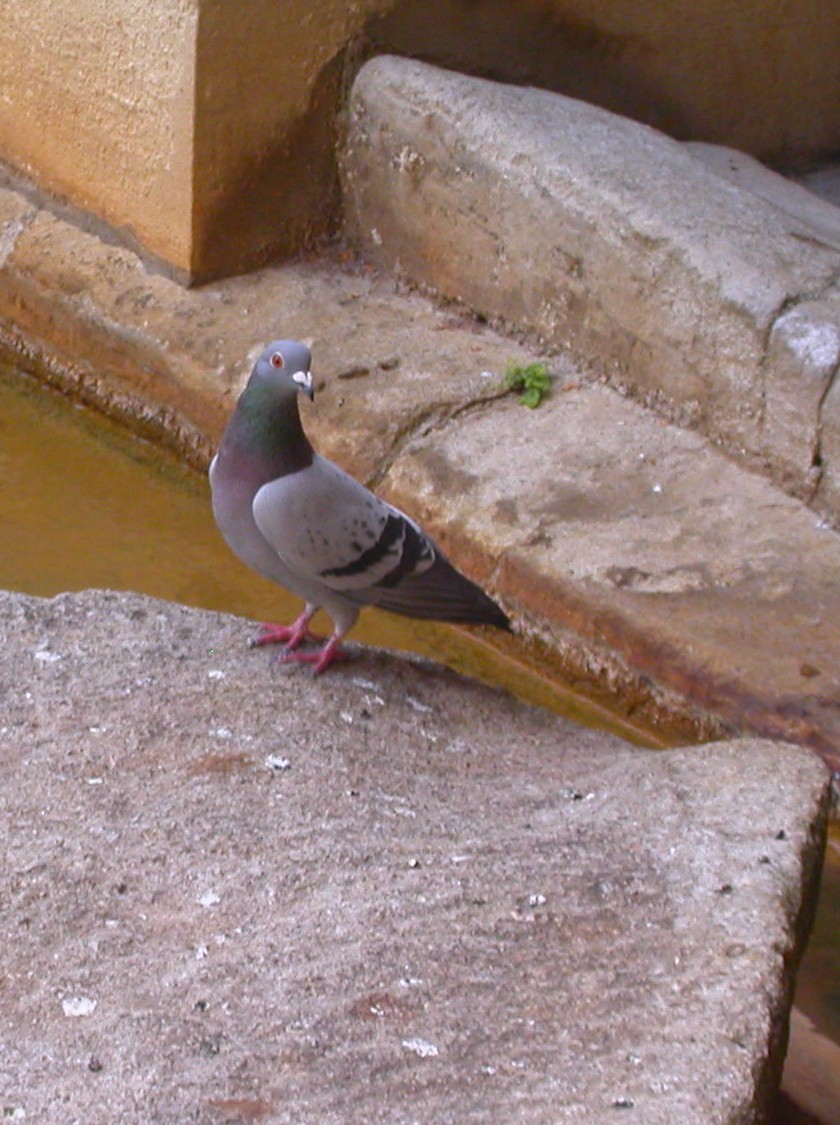
Right: One of many visitors to Aquae Sulis

Bathing is not allowed in Bath, at least not in the Baths. Of course one look at the water would encourage a desire to shower. Somewhere else. During Roman rule this place was called Aquae Sulis after the local goddess who provided Britain’s only natural hot mineral spring, a real attraction for bath-loving Romans. They had the good sense to roof the place over so pigeons wouldn’t shit in it from morning until night, which the Victorians who rediscovered it twenty feet beneath a row of flooding houses in the 1850s did not. So you probably wouldn’t want to bathe where the Romans did, but the water that flows into the spring is clean enough to drink after 10,000 years of natural slow filtering since it fell as rain in the local hills - and before it gets exposed to the depredations of pigeons - and the British have been drinking and immersing themselves in that water since before they ever heard of Claudius or Julius Caesar. It has been rumored to cure any malady you can come down with. Finding the Roman incarnation of the place conveniently situated to the springs they were still bathing in was a bonus for the 19th century residents of Bath. Even now, after nearly everyone has stopped believing in the curative powers of the waters, about a million people a year still show up just to see the place. My glass of Bath water was free with my admission, so before I left I took myself to the Pump Room, where Jane Austen used to partake of the local social scene, and tried a glass. It was quite warm, having been drawn from a bronze fish’s mouth directly at the “King’s Spring,” a little mineralish, and not at all bad compared to London tap water.

Jane Austen lived here for five years, off and on, and never warmed up to the place. Even in 1801 it was full of tourists, being right between its height-of-fashion pleasure mecca period and its British-equivalent-to-Florida retirement mecca period. It was too noisy for a country girl, and too bright (white stone neo-classic buildings were all the rage), and she wanted to be back in Hampshire. The day I went it was also hot and crammed with shoppers, and I got lost a lot on account of the rather cavalier attitude towards street names on the tourist maps, but a pot of assam and a couple of crumpets with marmalade in the tea room on the top floor of the Jane Austen Centre in Gay Street kept me from expiring.

I was feeling a bit pensive, thinking about Jane’s too-short life, too much of which was spent in relative poverty after the death of her father. At least she didn’t have to die to be successful; her books were popular once they finally saw publication, and made her some money in the last six years of her life. I’m an avid fan of Jane’s – I can read Pride and Prejudice and Persuasion, particularly, every year or so, and still feel the same emotional suspense as I did the first time. That’s a gift: Jane’s remarkable gift, and her gift to me. “Here’s to you, Jane.” I raise my teacup in the general direction of Winchester Cathedral, where her headstone bears no mention of her slightly disreputable profession. “Here’s to you, old girl.”

06 June 2006

Here There be Romans


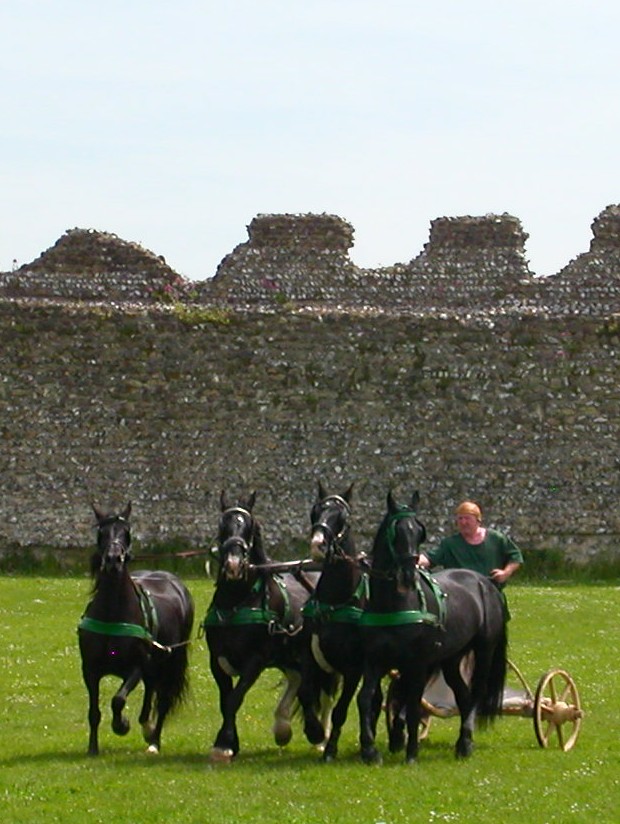
Right: Quadriga and Roman Wall, Porchester, Hampshire

You probably thought there were no Romans left in Britain, but there were dozens of them running around Porchester on Sunday, and the proof is in the photograph (More are available via the link to photos at the right). Members of three Romano-British re-enactment groups – the Ermine Street Guard, Britannia, and ERA (End of the Roman Age) turned out in force and fancy-dress for English Heritage’s Roman Festival held there over the weekend. They fired ballistae, ran one another through with swords and spears, and demonstrated Britain’s first reproduction of a Roman racing chariot, here driven by Tony Smart, who provides horses and his riding skills for films and TV.

The four-horse racing chariot, or quadriga, was donated to English Heritage by Time Team, a popular archaeology show on British TV. The show’s archaeologists had excavated a chariot-racing track, and subsequently commissioned the reproduction of a chariot to run on it. Although no hard evidence had been found before last year , it had been long surmised that there must have been chariot racing in Britain during Roman rule. Chariot racing was bigger than football, bigger than lions eating Christians, bigger than anything in Roman entertainment. Chariot racers, who seldom saw the far side of 30, were celebrities on a scale we can scarcely imagine unless we envision David Beckham being canonized after winning the Nobel Prize. The most famous chariot-racing riot in history resulted in 30,000 deaths, which makes a football riot seem like a few of the lads messing about after a match.

Three more quadrigae are being built, and next year’s festival will feature a race among the four famous Roman racing factions: the Blues, the Greens, the Reds, and the Whites. Perhaps English Heritage can organize modern Britain’s first chariot-racing riot, and if that doesn’t sell admissions, I don’t know what would.

Dev Agarwal had kindly agreed to chase Romans with me again, and we drove down to Hampshire (Jane Austen Country) on England’s south coast Sunday morning and spent the hottest day of the year to date watching demonstrations of battle tactics, sword- and spearplay, and Roman field surgery. I cannot imagine running around in armor, helmets, and in some cases bearskins, as these hardy re-enactors did, and they did it with smiles on their faces. There’s a photo of Dev looking remarkably cool in the ruins of Porchester Castle among the other “best-of” shots of the day – just follow the photo link at right. After collecting sunburns and souvenirs (I found the perfect desk accessory for you, Mr Dougie), we battled traffic back to Whitton and had coffee and dessert with Terri and Rani before I headed for home, nicely satiated with conquerors and tiramisu, to spend the evening reading slush. I would dearly love to be back next year for the big race.

30 May 2006

Peter Pan


Right: Peter Pan, Kensington Gardens

American children of any generation later than mine have their image of Peter Pan from the same place they get entirely too many of their childhood icons: Walt Disney. I suppose that malady is worldwide now. People grow up without seeing the illustrations of Sir John Tenniel or Ernest Shepard, but carry a whopping technicolor image in their minds of Alice or Winnie-the-Pooh that’s just somehow wrong. So that’s Peter on the right, and the young lady looking up his little dress is Wendy Darling. Everyone else is a fairy or a cunning woodland creature. Every child or former child, finding him- or herself in London, really needs to pay a visit for childhood’s sake, as I did on Sunday, queueing up with much younger children for my chance to take this photo.

If you skipped Disney and read the book (I pre-date the animated feature, so got my Pan straight from Sir James Barrie), you might remember that Peter was scarcely the charming infant of the sculpture (created by Sir George Frampton in 1911 and placed in the park in 1912) by the time he was introduced to theatre-goers in 1904 and readers in 1911. Sir James’ Pan is a self-absorbed brat, and Tinkerbell is a tiny but murderous psychotic. Of course those are their darker sides; they’re really quite charming at parties.

But in spite of all the good, clean “Let’s go kill some pirates” fun to be had in the book, there are darker things being said here about the dangers of perpetual childhood. Children are creatures of impulse, mainly, and while we may scoff at civilization, it’s that process acting on us as children that, if we’re lucky, results in adults, or at least people who can wear the costume with authority. One day we’re merrily squashing bugs, and on some other day we develop compassion, and the journey to humanity has begun. Pan and the Lost Boys will be squashing bugs in the Neverland until the end of time. Girls – in the person of Wendy – are the civilizing influence the boys didn’t realize they needed until they had her. The Neverland makes you forget though, so you may be sure they don’t miss her now she’s gone. And as for Tinkerbell, she’s just laughing her ass off.

22 May 2006

Touching the Mystery


Another day out. I could get to like this. My friend Alison White wanted me to meet her mother, who lives over here, and we decided to meet in St Albans, formerly the Roman city of Verulamium, even more formerly the Catuvellauni stronghold of Verlamio. Americans never quite get over how bloody old everything is over here. We live with a persistent notion that our country emerged from the brow of John Adams, et al, in 1776, and before that there just wasn’t anything. (Steve Martin, showing Victoria Tennant around Los Angeles in L.A. Story: “Some of these buildings are more than twenty years old!”). We all have to take American History in high school, but in my time at least, it was only the history of Europeans in America, which they could have covered it in six weeks and let everyone go home early.

Our plan was for lunch and a walk around the Verulamium Roman museum and the ruins of an amphiteatre that were somewhere about. We did get to the museum eventually, but skipped the amphiteatre on account of rain. Carolyn, along with John Thurgood, picked me up at St Albans rail station. Carolyn and John are delightful, warm, intelligent people, and I felt welcomed the moment I stepped through the station turnstile. We spent a chatty and companionably long lunch hour at a 700-year-old pub, the Old Tudor Tavern. Carolyn obtained some history from the bartender: The place was formerly two coach inns, the Swan and the George, and the very beams above our head were original to the 14th century, when pilgrims on their way to the monastery and cathedral stopped here. You had to be somebody important to stay at the monastery, so it was surrounded by inns like this one for the rest of us, around which the present town grew up. We were parked near the cathedral, so we decided to check that out first and find the museum later.

We had only been wandering around near the doors a few minutes when John alerted us that a guided tour was about to start, and we joined it. On our own we would probably have spent 30 minutes looking at the architecture and gone on in search of the real reason for the day out – Romans again – but once under the spell of our tour guide, a man who clearly loved this church and all it represented to him, we followed along to the end, which took at least an hour and a half. I won’t tire you with endless details, but a look at the nave will help you understand why we felt compelled to see the rest and listen to our guide’s seemingly endless store of historical anectdotes.

The longest and highest church nave in Britain is no-nonsense 11th century Norman architecture on one side, with faded frescoes on every pillar, and elaborate 14th century gothic stonework on the other side, owing to a partial collapse and rebuilding. In some places along the older side, parts of gothic arches emerge out of Norman plaster walls as though planned by some distant ancestor of H.R. Giger.

The original church, dating to the 8th century, was built around a shrine housing the remains of St Alban, the first British martyr. A wealthy Roman citizen, Alban had given his life in place of that of a Christian priest under his protection. There’s a very brave story involved, which is probably apochryphal, but that’s not the point; the point is that it is a brave story, full of compassion and selflessness, and it moved people. In addition to lots of other, more self-serving reasons, people journeyed here to touch the mystery of St Alban and be moved. They didn’t have TV, so they couldn’t just stay home and watch American Idol as one does in these more enlightened times.

In 1539 the Catholic church was outlawed in England, and the monks fled, one with a bag hidden inside his robe containing the bones of St Alban. The bones ended up in Germany, and would not return until about twenty years ago. The shrine that had housed them for centuries before the Reformation, a delicately-pillared structure of Welsh marble, was broken up into about 2000 pieces and hidden in nearby walls. Its location was forgotten, and when some of it was found by accident during the 20th century, the rest was recovered from hiding and painstakingly reassembled in a process that took a team of archaeologists more than ten years. It now rests on a dais in its own chapel, surrounded by an iron railing, still overlooked by a 700-year-old carved oak hiding place where monks once watched to make sure pilgrims’ gifts remained unmolested.

At the end of our tour, our guide explained that he was a Roman Catholic who held some office or other in a very ecuminical Anglican cathedral, and by exercising his priveleges (after apologizing for a demonstration of excess pride) he could allow us to touch the shrine. He opened a gate and we filed inside. I placed my hand on something created when my ancestors were driving the Vikings back to Dublin, something that had drawn people from all over Britain to St Albans in a time when most people never got five miles from the spot where they were born, and I absolutely felt something. All the centuries between those people and me just faded away, and I felt the weight of all those stories. The air around that chunk of carved marble containing a pile of 1600-year-old bones was thick with stories, and for a moment it felt like I was touching all of them. It was a mystical experience of the sort only a person as irreligious as myself could have – a person who holds no faith in Alban’s sainthood in the eyes of a personal God she doesn’t believe in, but is perfectly willing to accept (along with Joseph Campbell) that any place can be holy if you draw a circle around it and say “This is a holy place.”

16 May 2006

But I Do Know What I Like...


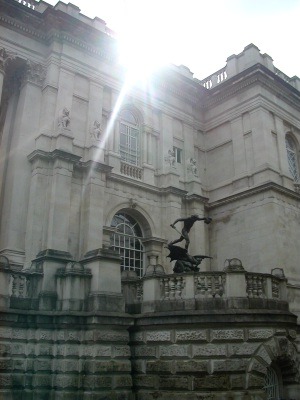
Right: The Tate Britain, North Side View

There are about a thousand good reasons to visit the Tate Gallery (Britain). Only one of them is that it’s a mile from my Kennington digs, just across the Vauxhall Bridge. The collection is vast, and you never see exactly the same mix twice, but the most famous pieces are probably up all the time to avoid disappointing visitors. If you love art there’s nothing to compare with walking into one large room and seeing absolutely lyrical works by Sargent, Waterhouse, Leighton, Burne-Jones, Rosetti, and Watts all around you. And I only mention the ones I came back to see again after my last visit two years ago. On a quieter day I would have stood and gazed at them even longer than I did, and having the luxury to go back when I like, you can be sure I will. Waterhouse’s The Lady of Shallot is worthy of long and loving contemplation, as is Sargent’s Carnation, Lily, Lily Rose, a study of dusk light and flowers and children, and Burne-Jones’ King Cophetua and the Beggar Maid, the most amazing portrayal of a man lost in love that anyone ever painted. Watts' Hope is an allegorical piece, somehow the perfect portrait of the word.


Only a couple of rooms over is John Everett Millais’ Ophelia, likewise breathtaking. Ophelia was praised by Millais’ contemporaries as a landscape, which is odd, because its central figure is a dead woman and they could scarcely have failed to notice that. The landscape features are remarkable: for one thing the entire painting is foreground; there’s no fading or diminution of detail from the grasses on our side of the bank to the flowers in dead Ophelia’s hands to the greenery on the far side. This lends an effect of in-your-face life to everything that surrounds poor Ophelia, who was modelled by Elizabeth Siddal, floating in a bath warmed by lamps underneath. The landscape was painted from life, in Surrey, which proves there is life in Surrey (Hi, Molly!), or at least there was in 1851.


And that’s just some 19th century frost on the tip of the British painting iceburg: 17 rooms cover roughly the period from 1600-1899, another 12 or so deal with the 20th onward (and one entire gallery downriver, the Tate Modern). One immense room the size of six of the others is dedicated to the paintings of Joseph Mallord William Turner, who left his works to the nation when he died.


The first time I saw a Turner realtime, I was in the National Gallery (the one in Trafalgar Square, not the one in Washington, D.C.). I turned a corner and there it was, and I swear I stopped breathing. It was The Fighting Temeraire Being Tugged to her Last Berth to be Broken Up . Now what, you may ask if you’ve never seen this painting, could be of anything more than historical interest about a picture of two ships going slow on an ocean? If you have seen it you probably don’t need to ask. Turner himself referred to this painting as "my darling," and refused to sell it. J.M.W. Turner was in the ground before the second half of the 19th century got out of first gear, but paintings like The Fighting Temeraire and The Burning of the Houses of Parliament should still be teaching painters something about modern art. The Turner Galleries at the Tate also contain a lot of earlier landscapes that don’t affect my breathing, but it’s amazing just to see so much of his life’s work in one room.


Of course another reason to go to the Tate Britain is to contemplate the paintings of Walter Richard Sickert (1860-1942). But that’s a subject for another (darker) day.

12 May 2006

And so to bed...


Another issue of Æon SF put to bed, and this one was like a three-year-old after a cotton candy and three rides on the roller-coaster; for a while there we didn’t think it was going anywhere. It just stood there screaming, and we wished we were three so we could scream, too. I’ve spent the last few weeks trying to keep my brains from leaking out my ears, and I can’t imagine what the Seattle crew must’ve been going through. It’s a relief, I can tell you. Now go out and buy a copy. It’s a brilliant issue – our seventh – and has a wonderful Alan M. Clark cover and lots of superb stories and articles and columns and poems.

I’m pretty sure we decided on quarterly publication because it was so long between issues, but it doesn’t seem that long anymore, and now it’s time to finalize the contents of the next one. But first, a day off. Maybe two.

I remember the days when I could put in seven 16-hour days a week for weeks on end before hitting a wall. We were building a publishing company from scratch with no experience but lots of ideas, most of which turned out to be surprisingly good ones. I think Æon was the most brilliant one of all, but by the time it came along I was finding 12-hour days plenty of work for anyone, and allowing myself a lot more downtime. Lately I’ve almost forgotten how to spell downtime, but I think I can just about remember again if someone will write it down for me. My next communication will treat on some delightful feature or other of England’s teeming capital city. I have a list.

05 May 2006

Surveillance


Right: My Very Own CCTV Cameras!

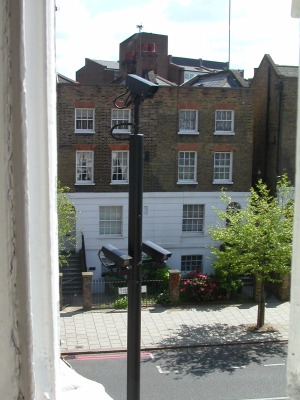
“We live in a surveilled society” a British friend told me some years ago. I had already noticed the many signs in public places announcing the presence of CCTV, but because I’m from the States, and didn’t expect to see cameras everywhere I looked, I didn’t. But I’m starting to see them now, like the one I noticed only today outside my window.

Scientists who study human perceptions already know that we don’t so much see what’s actually in front of our eyes as we reference snapshots we’ve already taken, and if we missed a detail when we took our mental snapshot we may continue to miss it until it calls itself to our attention, at which time it pops onto our landscape and we take an amended shot for later reference. Leaving the philosophical ramifications of that for a much later discussion, that seems to be what happened when I looked out my window a few hundred times without seeing the camera. But it’s there, right there in the picture. Not surprising there’d be one outside a pub, I suppose.

Of course there’s closed-circuit surveillance in the U.S., too, it’s just not nearly as ubiquitous, and I suspect we give it even less thought. If we did think about it we’d have to go through some changes, American-style: first, we’d have to feel outrage at the intrusion into our privacy, then relief that someone was keeping their eye on those other guys. As a visitor here I don’t think much of it one way or another, really.

Meanwhile I do my own surveillance. Kennington Lane at 0700 is populated by dustmen and other early-risers, the traffic starting to pick up a bit from the relative quiet of the relative dark hours -- it’s never either dark or quiet in London. By 0830 the commuters are out in force, and the vans and lorries, and the pavements are populated by brisk walkers-to-the-dayjob and mums holding kids’ hands on the way to school. These have slacked off by 0900, and out comes Thistledown Lady to sweep her portion of the pavement. Thistledown lady lives over Kennington Lane and down a couple of doors in a neat little house with a neat little garden out front that blessedly missed the craze for paving over front gardens in the 60s and 70s. Her iron railings are covered with rose bushes, and she has a tiny patch of neatly-mown grass. She comes out every morning to sweep the pavement and tidy up the garden, dressed immaculately and neatly, her hair a white pouf that seems to have settled onto her head from above on some errant breeze from the nearest wigmaker’s shop.

On weekends the traffic consists of fewer cars and more tour busses from Wales and Yorkshire and France and Germany. I can’t imagine what the tour guide is finding to say as they pass through the modest borough of Lambeth, probably “Cheer up, folks – we’re less than a mile from the Houses of Parliament.”

01 May 2006

Friends and Romans


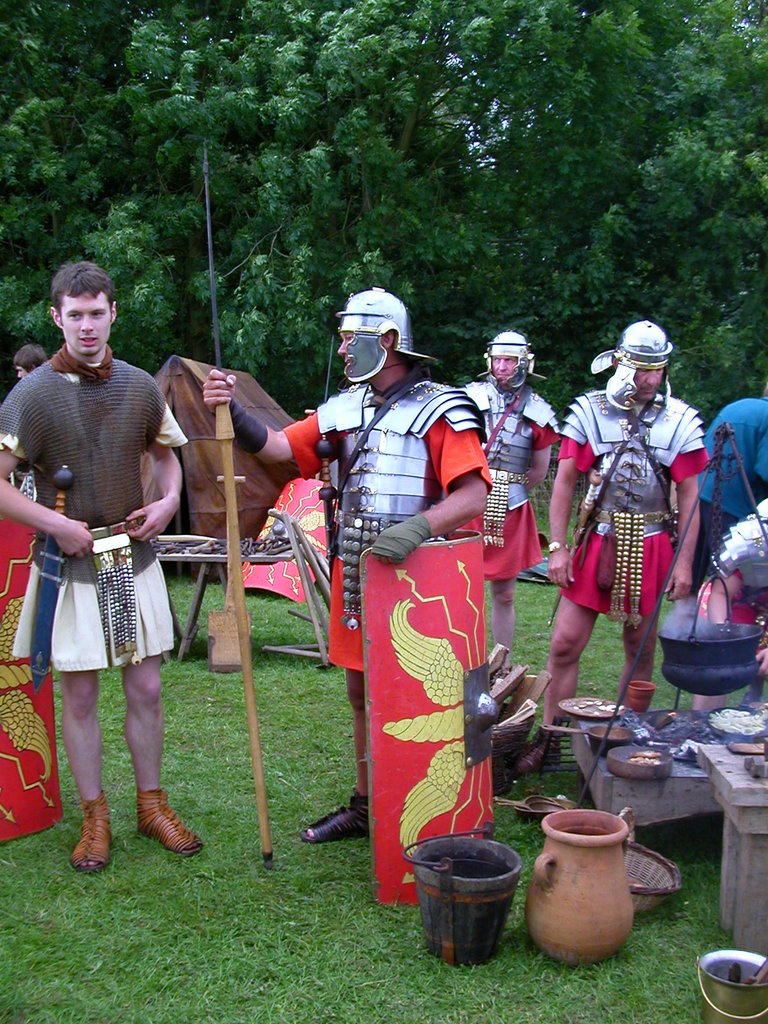
Right: The Romans did show up in Leeds – August 2005

I took a drive to Old Sarum yesterday with friend and Æon author Dev Agarwal, a fellow Roman enthusiast. English Heritage were putting on a Romano-British day, and we bravely set out from Whitton only two hours behind schedule, armed with our wits and a road atlas, the latter item being what saved us from driving pointlessly around Salisbury all afternoon. But I’m hours ahead of myself here in Salisbury, so let’s back up a bit:

There’s a truth every Briton knows and every visitor soon learns: “Never plan any travel on a Bank Holiday weekend.” The reason is that those weekends when most people do travel are also the weekends Transport for London and the various regional rail services that used to be British Rail schedule engineering works and station closures. So a 30-minute tube-and-overland rail journey to reach our meeting place in Twickenham turned into a 90-minute snafu of closed stations and detours and busses, and we hadn’t even gotten a start on the day out proper. Once we did, we managed the drive to Old Sarum (actually I managed being a passenger, at which I excel) without getting lost more than twice. It had been raining all morning, but we outpaced the weather and arrived at a stunning English springtime in Wiltshire.

Old Sarum was there as advertised, and English Heritage, and there were interesting demonstrations of Roman cookery and engineering, but the actual Romans seem to have marched past the whole thing, and by now are probably encamped somewhere in Devon. Their participation was sorely missed; we had all come there expecting to see a cohort of Britain’s ancient oppressors smiling for the cameras, perhaps a few camp-followers and Romano-British brats running about. As it happens the entire event consisted of two couples at opposite ends of a field, one roasting parsnips in honey (pretty good, actually) and the other operating models of ancient inventions.

An hour or so sufficed to absorb all this and walk around the ruins, and we were on our way back to Whitton and a late lunch with Dev’s wife (transplanted American writer Terri Trimble) and daughter (the irresistible Rani) at a café near their home. After tea back at the flat, and making the acquaintance of several friends named Piglet, it was back to good ol’ Room 3. I had managed to take my first complete day off in several weeks, and without experiencing the tiniest pang of guilt. As I suspected, all the work I left undone was still here waiting for me this morning along with more rain, and a lovely day out had done tons for my outlook.